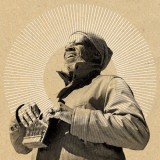
Two luminous multi-textured ambient drones by Duane Pitre/Pilotram Ensemble. Both compositions were improvised around a score by New York minimalist composer Duane Pitre utilising guitar, pump organ, violin, cello, viola, bass clarinet, alto saxophone and tone generator. Sonically placed somewhere between the minimalism of composer La Monte Young and the epic drone-scape ambience of Stars of The Lid, this is deep slowly-shifting mood music, or a monotone symphony.
"crystalline aural beauty...splendidly conceived and executed material...richness of overtones and s-l-o-w-l-y shifting modulations...gorgeously entrancing...the strength of the recording (Organized Pitches Occurring in Time), catapults Pitre just a split hair below the upper echelon of contemporary minimalism"
- Touching Extremes
"engrossing and exquisitely recorded" - The Wire
"Beautiful, stark, highly effective, and austerely compelling, “Organized Pitches Occurring In Time” is a genuinely brilliant release." - Foxy Digitalis
Credits
"The Ensemble Chord in Eb with a Minor 7th and a Pump Organ Base"
Duane Pitre - Guitar
Casey Block - Tone Generator
Craig Colorusso - Guitar
Julianne Carney - Violin
Lathan Hardy - Alto Saxophone
Jon DeRosa - Pump Organ
Tianna Kennedy - Cello
Eric Elterman - Viola
"The Ensemble Chord in C with a Major 7th and a Guitar Base"
Duane Pitre - Guitar
Casey Block - Tone Generator
Craig Colorusso - Bass Clarinet
Lathan Hardy - Alto Saxophone
Harry Rosenblum - Alto Saxophone
Julianne Carney - Violin
Scored by Duane Pitre
Recorded by Eric Elterman in NYC on 10/24/05 @ East Side Sound
Mastering by Carl Saff
Cover artwork consists of two paintings entitled 'I'm going for 72 degrees in my head, all the time' (acrylic on wood) by Joshua Krause
Notes
Organized Pitches Occurring in Time consists of two 25 minute pieces of music, both spawned from the same conceptual composition/score by Duane Pitre, titled Ensemble Drones. With their form reminiscent of works by La Monte Young’s Theater of Eternal Music and their tonality touching on the floating works of Terry Riley, 'The Ensemble Chord in Eb with a Minor 7th and a Pump Organ Base' & 'The Ensemble Chord in C with a Major 7th and a Guitar Base' are aural tapestries based on a minimal tonal palette with their instrumentation consisting of guitars, alto saxophones, bass clarinet, violin, viola, cello, tone generator, and pump organ.
The Ensemble Drones composition varies from the traditional sort as it is rule-based with the score consisting of a set tonic, set pitch classes, playing methods, technique restrictions, and spontaneous conduction. The score is a structure for the performing ensemble to improvise on - order spawning chaos producing order that is different on each occasion of a performance or recording. Ensemble Drones is discipline and freedom, both within each other, the first major focus of the work. Variance is the second major focus of the composition; with instrumentation, ensemble performers, tonic, pitch classes, and the physical space varying from performance to performance, the results can never be the same.
One way to view Ensemble Drones is like a compositional "body", as in the composition taking human form. The score is the skeletal structure that gives the "body" its general shape and feel. The pump organ, for instance, could serve as the circulatory system, the bass clarinet as the muscles, cello and saxophones as the internal organs, the electrically generated tones as the nervous system, guitars as the flesh, viola as the skin, violin as strands of hair, and the listener—the listener acts as the eyes. Not in the sense of vision, though—each listener will "view" the same compositional body differently, and, in return, the body will view itself differently with each new set of eyes. This helps to analogize the last major focus of the Ensemble Drones score/composition, which is perception.